Students Against Othering

Mission Statement

Students Against Othering’s (SAO) mission is to educate the public about the dangers and consequences of othering, specifically in relation to Muslims and Arabs. We here at SAO hope to educate the general public about the existence of othering, and how it effects many minority groups. We hope to raise awareness through showing identifiable examples of othering, and how this is a part of everyday life for targeted minorities such as Muslims and Arabs. Our goal is to show that our differences as human beings should be celebrated, and that we as a people should work toward understanding rather than assimilation. Respect, awareness, and understanding of different cultures are vital aspects to the solution to othering. Unfortunately, othering is one of the many results of unequal power dynamics, but we hope to convince people with and without power to treat one another with respect and understanding, and therefore diminish othering worldwide.
Showing posts with label Torture. Show all posts

Friday, December 3, 2010

Human Rights First


Human Rights First is a U.S. based nonpartisan, non-profit, international human rights activist group.  One of the issues that the group addresses on their website is torture; they produced a fourteen minute video entitled “Human Rights First Primetime Torture Project”.  This video was shown in class and is available in its entirety on the CTools site. 
The focus of the Primetime Torture Project is to depict how torture is represented in mainstream media and the dangerous effect this has on society.  The film consists of interviews with a variety of experts such as military interrogation specialists, military instructors, and screenwriters.  It also displays various clips from popular television programs featuring scenes of torture.  Scenes from programs such as Lost and 24 are especially compelling, particularly the character Jack Bauer.  Military experts in the video speak about Jack Bauer, and the impact his depiction has had on young military men; there has been a disturbing trend of trainees rebelling against using the interrogation tactics taught in class and attempting to use torture techniques, in the method of Jack Bauer.  This is just one of the many examples the video cites as evidence of how representations in the media of Arabs, Muslims and torture can have harmful results.
            Watching this video also brings to mind the course term essentialism, which is related to the ideas of othering and torture.  Essentialism: “The idea that a group of people possess and can be characterized by an unchanging “essence”- that all members of a group “naturally” share the same characteristics.  Stereotypes are created from essentialist ideas…These essentialist ideas stereotype and over generalize diverse populations".  According to Said, Orientalism relies on essentialist notions about Arabs, Muslims, and the Middle East. According to Mamdani, “culture talk” relies on essentialist notions of Arabs, Muslims, and the Middle East.”  I would argue that othering also relies on essentialist notions about Arabs, Muslims, and the Middle East.  As the Primetime Torture Project demonstrates, representations of Arabs and torture in mainstream media show them being stereotyped as terrorists- innately violent and hating the West.  Mainstream representations such as this feed into essentialist perceptions and create the stereotypes that are so prevalent in American culture.  These stereotypes lead to increased othering and the end result is a military that resorts to torture and a society that allows it.  An analysis of power dynamics is also innate to the examination of othering, essentialism and torture, as the person of power in this situation is always the torturer while the person being tortured is without power.  This can align with general world power standing or represent the reverse (as in the torturer may be from the generally more "powerful" group or may be a member of the less "powerful" side).
            Professor Alsultany writes of this same phenomenon in her article, “Representing the War on Terror in TV Dramas”.  Alsultany’s piece is an analysis of the different strategies that producers and writers have used in mainstream media representations of Arabs and Muslims; she identifies seven different strategies which attempt to show that not all Arabs are terrorist and vice versa, but she posits that, “they remain wedded to a script that only represents Arabs and Muslims in the context of terrorism.” (1).  Alsultany also writes, “However, in response to increased popular awareness of the ethnic stereotyping, and the active monitoring of Arab and Muslim watchdog groups, television writers have had to adjust their storylines to avoid blatant, crude stereotyping.” (1).  In other words, producers and writers have at least attempted to portray a less essentialist, stereotypical representation of Arabs and Muslims, but as Professor Alsultany’s article and Human Rights First’s video show, unfortunately it has not been enough.  Othering, stereotyping and essentialism still prevail.

by Anna Brown
Works Cited 
Alsultany, Evelyn.  "Representing the War on Terror in TV Dramas"
Course Guide Term List: “Essentialism”


Installation Project


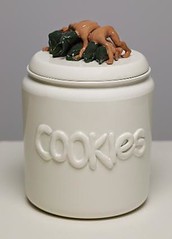
Item 11: Abu Ghraib Cookie Jar

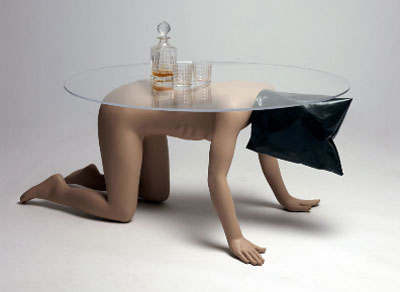
Phillip Toledano’s installation project is a thought-provoking compilation of artwork based upon the idea, “If American foreign policy had a gift shop, what would it sell?”  Toledano critiques various foreign policies of the past eight years through the representation of various objects that are traditionally given as souvenirs.  In Toledano’s words, “At the end of a trip, we buy a souvenir to remind ourselves of the experience.  What do we have to remind ourselves of the events of the last eight years?  And who will be held accountable for what has unfolded?  Once the sugar coating of the ordinary dissolves, we are left with the grim truth about where we’ve been as a nation.”  Many of the eighteen items in Toledano’s display portray actions and policy related to torture.
Item 5: Abu Ghraib Bobble-head
            Of these items related to torture, all are explicitly linked to the torture of Arabs and Arab Americans.  For example, Item 1: Inflatable Guantanamo Bay Bouncy Prison Cell, Item 2: Abu Ghraib Coffee Table, Item 3: I Was Rendered (T-Shirt), Item 5: Abu Ghraib Bobble-head, Item 10: Secret Prison Postcards, Item 11: Abu Ghraib Cookie Jar, and Items 15/16: Fairground Cutout (without and with people).  The fact that so many of the 18 items in the compilation are regarding torture in the Middle East is disturbingly representative of how pervasive these actions have been in American foreign policy in recent years. 
Item 10: Secret Prison Postcards
            Taken out of context, Toledano’s work could easily be interpreted as flippant, disrespectful, disturbing and even disgusting.  Within the context of his mission statement, however, Toledano’s pieces are an insightful look at America’s actions abroad, and the way in which he demonstrates torture through such mundane objects really highlights its grotesque nature.  Item 2: Abu Ghraib Coffee Table is especially poignant and immediately draws to mind the infamous images that were leaked from the Abu Ghraib detention center. 
Item 2: Abu Ghraib Coffee Table
As an artist making a political statement, Toledano’s pieces can be interpreted as a form of counter culture: “Ensemble of practices associated with various kinds of outsiders (e.g. disenfranchised groups such as the poor, immigrants, etc.) from which comes a critique of authority and attacks on what is official and commonly accepted.”  Using art as a medium, Toledano is blatantly critiquing widely accepted American foreign policy and is, in fact, making a call to action: “Fingers must be pointed, and pointed publicly.  Then, and only then, when the world sees us acting as we tell the world to act, will America’s honor be restored.”
Toledano’s collection also calls to mind the blatant othering that is present in American foreign policy and how this is reflected in the acts of torture that are depicted.  Steven Salaita speaks of this in his article, “Anti-Arab Racism in the USA”.  Salaita raises the issue that in discussion of torture at Abu Ghraib, “the racism of the abuses was hardly mentioned” (190) while, “…most rationalizations of Abu Ghraib insinuated, or stated outright, that the United States is more civilized than and therefore superior to the Arab World.” (191).  Salaita goes on to say, “…the abuse of so-called inferior peoples isn’t now an aberration and never has been; there would be no United States if the abuse of countless Others had never happened.  To forget this history is tantamount to validating it.”  Salaita’s words are in direct alignment with Toledano’s mission statement which calls for not only a remembering of the actions of the United States, but an examination of foreign policy and who is responsible it.  Othering clearly plays a dynamic role in all facets of this issue and the beauty of Toledano’s artwork is that it becomes impossible to ignore the ridiculousness of viewing a torture victim as the Other, rather than a human being.  Toledano's work also provides a visual analysis of power dynamics, representing the United States as the group with power, just as it so often is in real life and almost always is in realtion to the Middle East.  Unfortunately, having power often turns into abusing power, and torture and Toledano's depiction of it is a perfect example of this trend.

by Anna Brown
Works Cited
Course Guide Term List: “Counter Culture”
Salaita, Steven.  “Anti-Arab Racism in the USA: Where It Comes from and What It Means for Politics Today”


Mythbusters


According to the Discovery Channel website: “The Emmy®-nominated series MYTHBUSTERS aims to uncover the truth behind popular myths and legends by mixing scientific method with gleeful curiosity and plain old-fashioned ingenuity to create a signature style of experimentation.”  In other words, Mythbusters is a reputable program that appears on an educational channel that is intended not only to entertain, but also to inform.  Through scientific experimentation the team tests various myths and declares them either confirmed or busted at the end of the segment. 
One of the “myths” that the team tested in Episode 25 of the 2005 season was pertaining to Chinese water torture; the premise was that, “Chinese water torture can cause one to become insane.”  Two team members were subjected to Chinese water torture, one restrained and one unrestrained.  The myth was “confirmed” with the final conclusion as follows, “The required torture equipment (and involuntary movement restrictions) is highly effective even without adding the discomfort of the water drip. The water drip itself, without the equipment, is almost negligible.”
The team member that was restrained, Kerry, lasted approximately 1.5 hours before they ended the experiment.  Kerry became extremely upset during the experiment, experienced claustrophobia, and even cried.  In her own words, “It was much scarier than I had expected…I think this actually would be a very good torture…I knew that I could get up at any time, but the restraints totally made me lose it.”  Adam, the team member who was unrestrained, lasted significantly longer (over 3.5 hours) and eventually stopped the experiment to use the restroom.  Even Adam conceded, however, that the torture method could be quite effective: “I felt the pressure.  With the restraints it would have been a horrible experience.”
This portrayal of torture in the media is particularly interesting in that it is depicted in the format of an educational program rather than a more glamorized, Hollywood style show such as 24 or Law and Order.  This makes it perhaps even more disturbing, as this program is intended to be taken more seriously and the topic of torture, at least at the beginning of the experiment, is handled in a very light-hearted tone.  Gerald Gray, a counselor from the Center for Survivors of Torture, is consulted and appears very somber throughout the clip, but the team members themselves don’t seem to grasp the gravity of torture until they witness first-hand the effect the experiment has on Kerry.  For example, while building the “rack” one team member jokes, “Why are we going through all this trouble to build this water torture device?  I mean really, just buy them a six pack and they’ll tell you whatever you want to know.”
The use of “them” in this statement is very telling in that it represents the classic “us versus them” mentality that is associated with the othering that effectively needs to take place in order to subject another human being to torture.  In his statement, the team member not only jokes about torture, but depicts the idea that torture is to be used on “them”, or the other.  This ties in with Ph.D. Candidate Atef Said’s article, “Abu Ghraib Torture in Iraqi Narratives” in which, in his second narrative, Said proposes that the torture of prisoners at Abu Ghraib should be viewed as attacks against Islam and Muslims.  This theory proposes that the use of torture on Iraqi prisoners was a result of the rise of Islamophobia in the West, specifically in the U.S, and that the increase of Islamophobia had an impact on the ideology of the U.S. army, casting every Muslim as a “potential terrorist”.  In other words, in this case, “them” would be Muslims (perceived as terrorists or potential terrorists).  This "us versus them" mentality also represents power dynamics with, from the United States' perspective, "us" having the power. 
This episode of Mythbusters is also relevant in the debate between torture and torture lite: “Since torture is illegal according to the Geneva Conventions, the U.S. devised “torture lite” after 9/11 in an effort to torture suspected terrorists within international law.  Most critics say that there is no real difference between torture and torture lite, except for semantics.”  Many would attempt to qualify Chinese water torture as torture lite, as it does not violate prohibited interrogation methods such as physical abuse, using hoods, using military dogs, etc. (all of which took place at Abu Ghraib).  Cast member Kelly, however, clearly doesn’t share this same sentiment.  After experiencing Chinese water torture for herself Kelly said, “Absolutely it would be a torture.”

byAnna Brown
Works Cited
Course Guide Term List: “Torture Lite”
http://mythbustersresults.com/episode25
Said, Atef.  “Abu Ghraib Torture in Iraqi Narratives”